Syllabus
See also the full syllabus PDF.
- Course Code: LAI 605
- Instructor Name: Dr. Chris Proctor
- Class Times: Asynchronous
- Email Address: chrisp@buffalo.edu
- Office Location: Foster 361b
- Office Hours: By appointment
- Credits: 3
Course Description
This course centers critical computational literacies as a framework for thinking about how and why we might integrate computing into K12 education, including Computer Science (CS) and artificial intelligence (AI). We explore these questions at multiple scales, ranging from individual classrooms, to the breadth and length of a student's experience in school, to how schooling is shaped by and shapes our society. At each scale, the course is designed to encourage students to reflect on their own experiences and identities, to understand their relationship to broader structures and forces, and finally to articulate their own stance as educators.
Learning Outcome and Program Goals
Course learning outcomes
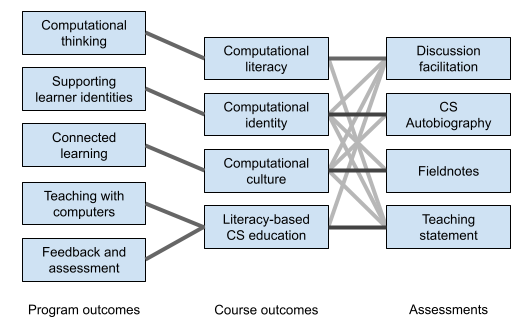
- Computational literacies: Understand, participate in, and critique the multiple ways CS can be defined as a K12 disciplinary subject and the consequences of these definitions for teaching and learning.
- Computational culture: Understand the relationship between disciplinary learning goals and broader educational priorities such as culturally-sustaining pedagogy and interdisciplinary computational literacy.
- Computational identities: Understand the needs and perspectives of diverse Computer Science learners, including specific factors within Computer Science which have historically marginalized students and how they can be mitigated.
- Literacy-based CS education: Own your own stance as a teacher, and know how you intend to put your beliefs into practice.
Program Goals
Critical Computational Literacies is part of all of UB's CS Teacher Preparation tracks, described in greater detail in the CS Education Handbook. Figure 1 shows the relationship between program outcomes, course outcomes, and assessments.
Mode of Instruction
Critical Computational Literacies is an asynchronous online course with online or in-person synchronous discussion group meetings scheduled at the convenience of students. Regular attendance, preparation, and participation in discussion group meetings is essential and required.
In the first week of the course, students will be assigned to a discussion group based on regular weekly availability. Students are expected to attend this discussion group regularly. Each student will facilitate the discussion group on a rotating schedule. Facilitation involves completing the readings ahead of time, preparing questions or quotations to lead the discussion, and writing up a brief discussion report, to be submitted no later than Saturday night each week.
Each Monday, the instructor will post a ~30-minute video introducing the week's topic and readings, and synthesizing and responding to the discussion reports from the previous week.
Required Text and Materials
There are no texts required to be purchased for this course. All readings are accessible from the course website or through UB's institutional journal subscriptions. You will need regular access to a computer and a stable Internet connection.
Course Assignments
There are three assignments in the course in addition to regular participation in discussion groups. Each is summarized below; more specific guidelines and examples are available on each assignment's page.
Discussion group facilitation (20%)
Regularly complete the readings ahead of your discussion group's weekly meeting, participate in the meeting, and facilitate when it is your turn. After you facilitate your group's weekly discussion meeting, submit a discussion report no later than Saturday night of the same week. The instructor will synthesize and respond to discussion reports in each weekly video.
Discussion report format:
- Should be 1-2 pages, single spaced.
- Label each report with the group members in attendance (with facilitator noted), the date of the meeting, and the readings discussed.
- Include the questions, themes, quotations, or any other preparation made by the facilitator (up to ½ page).
- Include notes on the content of the discussion -- big ideas, issues that felt important, unanswered questions, etc. The primary audience of discussion reports is the instructor. Attribution of comments to individuals is encouraged, but reports are also public to other members of the course, so leave out anything sensitive shared in discussion that you don't wish to share more broadly.
Assessment criteria:
- Regular preparation, participation, and facilitation, as described above.
- Engagement with readings. Substantial and specific reference to ideas in each week's readings, generally including specific quotations. It is not necessary to summarize readings or respond to every idea, but the ideas you take up should be put in accurate context of the text and of other relevant texts exploring those ideas.
Computer Science Autobiography (20%)
Write your autobiography as a computer scientist or as a computer science learner, reflecting on how you understand your identities with respect to CS and how these understandings have developed through past experiences.
Ethnographic Fieldnotes (20%)
Visit a Computer Science learning environment (broadly understood), jot fieldnotes, and process them into observations and interpretations of the Computer Science learning which took place. Rather than writing these up as a formal report, submit your (cleaned-up) fieldnotes in a format which distinguishes between observations and interpretations. Additionally, prepare a five-minute slide presentation sharing several interpretive findings along with the observations they were based on.
Teaching statement (40%)
Define your stance as a computing educator, including your working definition of K-12 computing education and your understanding of the relationship between disciplinary content knowledge and broader goals such as culturally-sustaining pedagogy and interdisciplinary computational literacies. Describe the context in which you expect to teach computing and articulate a vision for how computing might contribute to the broader learning ecology.
Grading
Each of the major course assignments will receive a holistic grade and qualitative feedback. One round of resubmission is available for all assignments (time permitting), to be submitted within two weeks of receiving feedback and in all cases no later than two weeks before the end of the course. When resubmitting, students should include a revision note (one page, double-spaced) responding to the feedback and explaining what has been changed.
Attendance and participation are expected but are not graded. Similarly, you are expected to complete work on time but there is no grade penalty for lateness. If grades are meant to be a measure of learning or of work quality, I cannot see a justification for lowering grades due to missing class or turning work in late. Instead, I interpret these behaviors as signals that you may be having difficulty in the class, and will check in to see if there is a way I can better support you.
See also Department-wide policies.